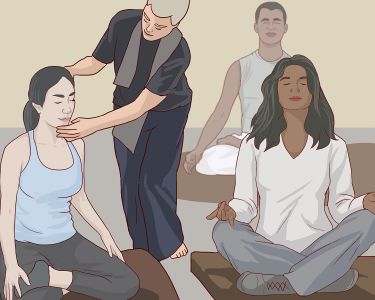
Mental freedom is a precious skill that needs to be cultivated. The ability to free your mind from constant justifications for the misfortunes that haunt us brings true relief. In this article, we will explore the path to freedom, which includes a set of skills aimed at letting go and creating happiness.
Part 1
Step 1. Prepare for a Long Process.

Be ready for the fact that this journey will require time. Freeing your mind is an ongoing process that demands proper recognition, thoughtful thinking, mindful speech, virtuous actions, hard work, a healthy lifestyle, mindfulness, and focus. All these aspects make up the eight steps on the path to Truth, and the term "right" implies skilled or beneficial. Use the list below to reflect on how to apply these skills in your life and recall moments when they might have helped you.
- It's like a culinary recipe: if you use the right ingredients, you will achieve the desired result. However, if something is missing or mixed incorrectly, success will be unattainable. Many ingredients work in harmony, supporting each other on the way to the goal.
- It’s important to put in the right efforts, as there are also wrong ones. Simple efforts, vigilance, and concentration are not enough. Buddha's biography proves that he used eight components in various forms, constantly combining and adapting them. Only when the goal was clear did these elements work together to yield results.
Step 2. Consider the First Step - "Right Understanding".

Pay attention to the first step of the eight - "Right Understanding". It largely relates to studying the Four Noble Truths of Buddhism, but overall, right understanding is based on the awareness of change. Everything around us changes regardless of our desires, and we cannot expect perfection or eternal happiness from it.
- Right understanding also involves the aspiration to become a virtuous person, engage in mental development, and accumulate wisdom, as these three aspects support each other and the eight steps of the path.
Step 3. Start Applying "Right Thought".

Apply "Right Thought" wherever possible. It encourages kind thoughts, understanding, and generosity while rejecting greed, hatred, and false beliefs. Right thought requires having right understanding; otherwise, it is challenging to distinguish which thoughts are skillful and which are not.
- Practically, the four "Divine Abodes" are beneficial: loving-kindness, compassion, appreciative joy, and equanimity (or acceptance). While knowledge of the Four Noble Truths may seem dull, the virtues supporting the Divine Abodes can not only eliminate negative emotions but also create an atmosphere of happiness and well-being. When you experience desire, remember to express gratitude for what you have.
Step 4. Practice "Right Speech".

Work on "Right Speech". Your speech reflects your thoughts: negative thoughts generate harsh words. By eliminating harsh thoughts, you will not utter harsh words, as there are no mental intentions behind them. A positive mental state will enable you to speak more skillfully and constructively in conversation.
- It's also worth considering situations where discussion may be impossible, but right speech still accounts for this aspect, showcasing the virtue of your words.
Step 5. Analyze the Third Step - "Right Action".

Examine the third step - "Right Action". It stems from right thought: evil thoughts lead to evil actions. Right actions and speech should be directed toward harmlessness and stress reduction.
- Interestingly, right actions also help eliminate sources of stress. They support right thought and speech, as simply thinking about giving up bad habits and practicing beneficial ones is not enough; action is required to implement these intentions. This is one of the key points: the components of the path are interconnected and support each other.
Step 6. Carefully Consider "Right Livelihood".

Thoroughly explore "Right Livelihood". It involves efforts aimed at understanding and performing complex tasks. This requires focus: avoid excessive efforts that may lead to unnecessary tension, as well as passivity. Right livelihood implies balanced efforts without the intention to harm.
- In practice, right livelihood encompasses all other aspects of the path. Without effort, there will be no intention to act skillfully, and remaining inactive is significantly easier. But work requires the right perception, as it is easy to fall into abuse and lack of balance.
Step 7. Study "Right Effort" in Context of Your Experience.

Examine "Right Effort" and relate it to your personal experience and professional activities. This aspect requires avoiding work associated with cruelty and negativity, as well as any activities that question virtue, intellectual abilities, and wisdom. While such work is not always available, it's wonderful when there is an opportunity to grow in a harmless field.
- In practice, right livelihood does not necessarily match your current lifestyle. If you have a good job, it also implies right thought and recognition of the value of what you have while understanding that there are less favorable conditions in the world. If your work is unfulfilling but you can leave it at the door, that's already a step toward right livelihood.
Step 8. Explore "Right Mindfulness".

Familiarize yourself with the concept of "Right Mindfulness". Mindfulness is awareness of everyday actions and sensations in the body, awareness of your mental states, and how and when they arise. It is a constant practice that requires mental observation and awareness. Ideally, mindfulness incorporates right actions and understanding so that you know what to do when facing difficulties.
- Without awareness of what is happening, it will be challenging to apply right actions and refrain from aggressive thoughts. With mindfulness, you will be able to recognize stress and distinguish potentially harmful thoughts. However, for this, it is necessary to apply understanding and actions, and continually practice these components.
Step 9. Develop "Right Concentration".

"Right Concentration" enhances mental activity, maintaining alertness and attention. This skill can be developed both in meditation and in daily life. Without concentration, it is impossible to work skillfully and be mindful.
- In particular, concentration is closely related to a meditative practice known as dhyana or jhana. Immersion in meditation is an important skill worth developing, but remember that isolation will not solve problems. It can also lead to many misunderstandings and even panic when calmness fades. Dhyana can be seen as a magnifying glass for exploring the mind, but it is important to remember that meditation without deep immersion requires time and dedication.
Step 10. Explore the Interconnection of Components and Their Application.

Pay attention to the interconnections among various components and study how to apply them for your benefit. Many of them are intuitive, but you won’t know until you try. It’s important to remember that right understanding is the fundamental component upon which all others depend; without it, the other aspects lose their effectiveness.
Step 11. Implement These Principles in Your Life.

Start integrating these principles into your daily experience and observe how they begin to work for you. You will gain the most benefit by comparing your past and current experiences to see the differences. This will not only accelerate the process but also make it clearer as you recognize their value.
- It’s important to note that there is no "correct culture" or "correct traditions" in this group—they are merely "decorations" in life. These elements add color and interest, but if approached unreasonably, they can cause problems. Most failures are associated with people clinging to cultures and traditions that prevent them from moving forward.
- Buddha used a simple analogy: once people have crossed the river, they do not need to carry the boat on their heads. If you have reached the shore but remain in the boat, you will not be able to move forward. The journey may be long, but if you do not leave the boat behind, you will remain stationary and fail to achieve your goals. By using vigilance to understand things, you can free yourself from deception and move forward.