In the age of digital photography, it may seem odd to guide you on using 'outdated' 35mm cameras. However, many people still choose to shoot film for artistic (and other) purposes. Digital photography is used for almost every purpose except landscape photography, and the amazing 35mm mechanism is cheaper than ever.
Preparation
Step 1: Identify the main controls on the camera.
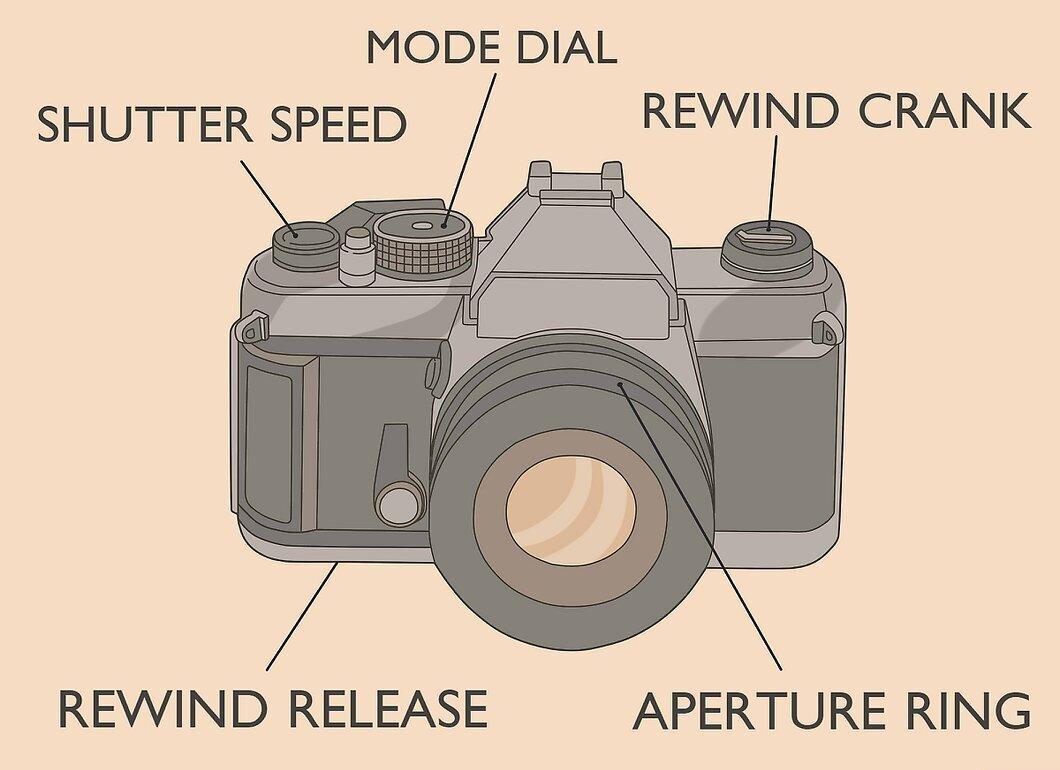
Look for the main controls on the camera. Some cameras may not have all of these, or some may not have any at all, so don’t worry if you don’t see everything described here on your camera. We’ll cover these in more detail later in the article, so this is a good opportunity to familiarize yourself with them now.
- Shutter Speed Dial on the Minolta XG-M: This sets the exposure time, or how long the film is exposed to light. More modern cameras (1960 and onwards) display this in regular increments like 1/500, 1/250, 1/125, etc. Older cameras might use odd, arbitrary numbers.
- Aperture Ring controls the aperture, which is a small opening near the front of the lens. While it doesn’t have a technical explanation, it’s a good starting point for more detailed information. They are usually marked in standard stops, and almost all lenses will have settings for f/8 and f/11. The aperture ring is usually on the lens itself, but not always; some later cameras (post-1980) allow you to control the aperture from the camera body itself.
- ISO Dial, which may be labeled as ASA, controls the film speed. This may not be a dial; it could be a series of button presses. In any case, it’s essential for cameras with automatic exposure mechanisms, as different shots require different shutter speed settings. For example, a shot at ISO 50 will require twice the exposure time as a shot at ISO 100. Some cameras may not require this, and sometimes it isn’t even possible; many later cameras don’t have this feature.
- Mode Switch sets different automatic exposure modes if your camera has them. This is often found on fully automatic electronic SLRs from the late 1980s onward. Unfortunately, all cameras have different modes; for instance, Nikon calls it